Best Heavy-Duty Garage Storage Shelves: How to Choose
Start with the total weight you'll store and divide it by the shelves you plan to use. Then match that number to a unit's real capacity, check the uprights and bracing, and measure your floor and doorway before you order garage storage shelves heavy duty enough for the job.
On this page (7 sections)
- How do you match shelf capacity to what you store?
- Why do uprights matter more than the total rating?
- How adjustable shelves change what fits
- What footprint and depth fit your garage?
- Which shelf fits each garage job?
- How do you assemble and load heavy-duty shelves safely?
- Which heavy-duty shelving should you buy?
Garage storage shelves heavy duty enough for your load start with one number: the total weight you'll actually store, divided across the shelves you plan to use. A unit rated at 5,000 lb sounds huge until you fill four shelves with paint cans, tool chests and a spare engine block.
The rating tells you what the frame can hold, not what one crowded shelf can.
This guide walks through what separates a real heavy-duty unit from a label. You'll see how uprights, bracing, adjustability and footprint change the answer, and where each of three shelves fits best.
How do you match shelf capacity to what you store?
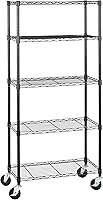
Match capacity by adding up the weight of your heaviest items, then leaving headroom. The VEVOR 5-Tier Shelving 48x24x72 carries a 2,000 lb total, which works out to about 400 lb per shelf across five tiers.
The SISESOL 71-Inch 5000 lb Garage Shelving rates 5,000 lb total. The RAVIGIN 79-Inch 7000 lb Shelving rates 7,000 lb across four shelves.
Weight adds up faster than most people expect. A full 27-gallon tote of tools can run past 100 lb.
Four of those on one shelf already strain a 400 lb limit. That's why you count the load first and pick the shelf after.
Don't fill to the rating on day one. Leave at least a quarter of the rated load free for shifting weight and future additions.
A shelf rated at 5,000 lb doesn't need to carry 5,000 lb to earn its keep.
If your storage is mostly totes and lighter boxes, a 2,000 lb unit is plenty. Save the big-rated frames for engine blocks, tile boxes, cement bags or a stack of power tools.
Our best heavy duty garage shelving roundup covers more units in each weight band.
Rule: pick a total rating at least 25 percent above the weight you plan to store, and never let one shelf carry more than its even share.
Why do uprights matter more than the total rating?
The uprights carry the load, so look at how they're built before the headline number. SISESOL uses one-piece upright construction with wider, thicker beams than a standard rack.
RAVIGIN also builds one-piece columns without joints and widens them beyond standard.
A joint in an upright is a weak point. A bolted or sleeved upright can loosen over time under a heavy load.
One-piece columns remove that failure point and keep the frame square.
Compare this with a budget rack where uprights bolt together in sections. Those units can work for light loads, but a 5,000 lb rating on a jointed frame deserves more scrutiny.
Weight per upright tells you the story too. The SISESOL unit weighs 80 lb empty, which signals thick steel.
The RAVIGIN frame carries its 7,000 lb rating on four uprights, so each column handles about 1,750 lb when evenly loaded.
Check the beam depth as well as the upright. A deep beam resists bending when a shelf is loaded in the middle.
SISESOL reinforces its beams specifically for this.
Rule: choose one-piece uprights and reinforced beams for anything over about 2,000 lb total, and skip jointed frames for really heavy loads.
Lateral bracing and diagonal braces
SISESOL adds 8 reinforced lateral bars that connect uprights and beams on the sides. RAVIGIN uses reinforced diagonal braces to spread weight evenly across the frame.
Both features fight the same enemy: side-to-side sway. A rack that wobbles when you push it will twist under a heavy load.
Bracing keeps the frame rigid.
Lateral bars run horizontally and lock the sides square. Diagonal braces run at an angle and redirect force down into the floor.
Either style helps, and both beat a bare frame with no cross support.
Rule: never buy a tall heavy-duty unit with no side bracing, and check the brace count against the height.
How adjustable shelves change what fits
Adjustable shelves let you set spacing around your tallest items, then fill the gaps. SISESOL uses locking pins to hold shelves in place at each position.
RAVIGIN's shelves adjust and lock with pins as well. The VEVOR 5-tier unit clips shelves in place at different heights.
This matters more in a garage than in a pantry. A tall tool cabinet, a pressure washer or a stack of paint buckets each needs a different gap.
Fixed shelves force you to waste space or leave an item on the floor.
Locking pins are the sturdier system. They pass through the upright and the shelf bracket, so the shelf can't slide out of its notch.
Clip systems are quicker to change but rely on the clip staying seated.
Plan your shelf spacing before assembly. Measure your tallest item and add a couple of inches for lifting it in and out.
Then set the bottom shelves tighter for heavy items and leave more headroom up top.
Rule: buy adjustable shelves with locking pins if you'll store mixed-height items, and set your spacing before you load anything.
Can you split a shelving unit?
The VEVOR 5-tier unit splits into two separate racks. That's useful when you move, or when you want one tall rack and one low bench-height rack in different corners.
Splitting changes the load math. Each half carries less than the full unit, so don't assume the split halves each hold the original total.
Recheck the load on each rack after you divide it.
SISESOL and RAVIGIN units connect multiple units side by side instead. That keeps each frame full height and spreads load across more uprights.
Side-by-side linking is the better choice for a long wall run.
Rule: split a unit only when you need two shorter racks, and treat each half as its own shelf with its own load limit.
What footprint and depth fit your garage?
Measure the floor and the doorway before you choose a depth. A 24-inch depth fits most large totes, but it takes up real floor space.
The SISESOL unit measures 71.3 in wide, 24 in deep and 70 in high.
The VEVOR is 48 x 24 x 72 in. The RAVIGIN is 79 x 24 x 79 in.
Width is where these units differ most. A 48-inch rack suits a single-car bay or a short wall.
A 71-inch unit fills a two-car wall. The 79-inch RAVIGIN needs a long, clear stretch of wall.
Height matters near the ceiling and the garage door track. The RAVIGIN stands 79 in tall, so check that it clears the door's travel and any overhead lighting.
The SISESOL and VEVOR units are both about 70 to 72 in tall.
Doorway width is the quiet deal-breaker. SISESOL lists a 71.3-inch minimum door width, so the assembled unit won't roll through a standard door.
Assemble it in place or move the parts through first.
Rule: sketch the footprint on the floor in tape before you buy, and confirm the unit fits through the doorway or gets assembled in place.
Depth and tote fit
A 24-inch depth holds most 27-gallon totes with a little room to spare. Deeper totes can overhang the front edge, which puts weight past the shelf's support.
If your storage is mostly totes, read our guide to garage shelves for totes for depth and shelf-gap advice. If you need to move a loaded rack around, our garage shelves on wheels comparison covers caster-rated units.
For a standard 48 x 24 footprint, our heavy duty garage shelving 48 x 24 page lines up more options.
Rule: match depth to your widest tote, and leave the front lip clear so nothing hangs past the shelf edge.
Which shelf fits each garage job?
Pick the unit that matches your load and your wall, not the biggest rating you can find. Here are the three shelves and the job each suits best.
VEVOR 5-Tier Shelving 48x24x72: best all-around for most garages
The VEVOR suits most two-car garages that need a tidy, adjustable rack without a huge footprint. Its 2,000 lb total rating covers tools, totes, paint and household overflow.
The 48 x 24 inch footprint fits a short wall or the space beside a door.
It uses SPCC carbon steel with a powder coating to resist rust and scratches. The shelves clip into place at different heights, and the unit splits into two separate racks when you need a shorter bench-height shelf.
Its lighter rating is the trade-off. If you store engine blocks or pallets of tile, you'll want more capacity.
For everyday garage clutter and a wall that isn't huge, it's the sensible pick.
Choose it for a standard garage with mixed loads and a modest wall. Skip it if your stored weight runs past about 2,000 lb.
SISESOL 71-Inch 5000 lb Garage Shelving: best for wide walls and heavier loads
The SISESOL suits a long garage wall where you want one big rack and real load capacity. At 71.3 in wide and 70 in high, it fills a two-car wall and rates 5,000 lb total.
The one-piece uprights and 8 lateral bars keep the wide frame rigid.
Its shelves adjust and lock with pins, and the anti-corrosion coating protects the steel in a damp garage. Multiple units connect side by side, so you can build a continuous wall run.
The width is also the catch. It needs a 71.3-inch door clearance to move assembled, so plan to build it in place.
And its 80 lb empty weight means you'll want a helper.
Choose it for a wide wall and a load in the 2,000 to 5,000 lb range. Skip it if your wall is short or your doorway is narrow.
RAVIGIN 79-Inch 7000 lb Shelving: best for very heavy loads
The RAVIGIN suits buyers with a genuinely heavy load and a long wall. Its 7,000 lb total rating is the highest here, and its 79 x 24 x 79 inch frame is the largest.
One-piece columns and reinforced diagonal braces spread the weight.
It has four shelves with locking pins and an anti-corrosion coating. The triple-reinforced design targets the very heavy end: machinery parts, large containers and dense loads.
Its size is the trade-off. At 79 in wide and 79 in tall, it needs a long wall and ceiling clearance.
It also needs a 79-inch door clearance, so it goes up in place.
Choose it when your stored weight runs past 5,000 lb and you have the wall for it. Skip it for a normal garage's mixed clutter.
How do you assemble and load heavy-duty shelves safely?
Assemble the frame empty and on a level floor, then load from the bottom up. A rack that starts square stays stronger.
Build it on a slope or an uneven slab and the uprights lean, which strains every joint.
Start with the base and one side. Add shelves at your planned heights, then square the frame before you tighten anything.
Locking pins and lateral bars go in last so the frame stays flexible while you adjust.
Load the heaviest items on the bottom shelves. That keeps the center of gravity low and reduces the chance of a tip.
Spread weight evenly across each shelf rather than piling it in one corner.
Leave the top shelf for light items like empty totes, seasonal decorations or paper goods. A top-heavy rack is the most likely to tip.
Check the rack after loading. Push gently on a corner and watch for sway.
If it moves, add a wall strap or recheck the bracing.
Rule: build empty and square, load bottom-up, and never put the heaviest items on the top shelf.
When to anchor a heavy-duty unit
A freestanding unit with wide uprights and bracing can stand alone when loaded evenly. Tall units and units on uneven floors are more likely to need a wall strap.
Follow the maker's instructions and anchor the top to a stud if the unit feels unstable.
SISESOL, VEVOR and RAVIGIN all use freestanding or floor-mount designs. None requires anchoring in normal use, but a strap is cheap insurance in a garage with kids or pets.
Rule: anchor the top to a wall stud if the unit is tall, narrow or on an uneven floor.
Which heavy-duty shelving should you buy?
Buy the VEVOR 5-Tier Shelving 48x24x72 for most garages. It covers everyday loads up to 2,000 lb in a compact 48 x 24 footprint that fits almost any wall.
Its adjustable shelves and split-into-two design make it the most flexible unit here for the space.
Choose the SISESOL 71-Inch 5000 lb Garage Shelving when you have a long wall and a load in the 2,000 to 5,000 lb range. Its one-piece uprights and 8 lateral bars handle the width well.
Choose the RAVIGIN 79-Inch 7000 lb Shelving only when your stored weight really runs past 5,000 lb and you have 79 inches of wall and ceiling clearance to spare. The extra capacity is real, but so is the footprint.
Measure your floor, doorway and load first. That one step will tell you which of these garage storage shelves heavy duty enough for your garage actually fits.
Our score weighs specs, features and buyer feedback against what you're shopping for.
Frequently asked questions
How much weight can heavy-duty garage storage shelves hold?
Most units sold as heavy duty hold somewhere between 2,000 and 7,000 lb in total. The three shelves here are rated from 2,000 to 7,000 lb, so read the total figure and the per-shelf figure together rather than trusting the headline number.
What is the difference between total capacity and shelf capacity?
Total capacity is the load the whole unit is rated to carry. Shelf capacity is the limit for each individual shelf, and it is usually lower.
Spread heavy items evenly so no single shelf carries more than its share.
Do heavy-duty garage shelves need to be anchored to the wall?
A freestanding unit with wide uprights and lateral bracing can stand on its own when loaded evenly. Tall, narrow units are more likely to need anchoring.
Follow the maker's instructions and add a wall strap if the unit feels unstable.
What depth should I choose for garage storage shelves heavy duty enough for bins?
A 24-inch depth fits most large storage totes and tool cases without overhang. Check the tote's footprint first.
A 24-inch deep unit also needs more floor space, so measure the spot before ordering.
Can I split a shelving unit into two shorter racks?
Some units can be split into two separate racks. The VEVOR 5-tier model can be divided this way.
Splitting gives you two shorter shelves, but each half carries less total weight than the full unit.