How Do You Hang Garage Shelves?
Here's how to hang garage shelves: attach the supports to studs or another mounting surface approved by the shelf maker. Mark a level layout, use the specified fasteners, and check every connection before loading.
On this page (9 sections)
- What should you check before buying garage shelves?
- What tools do you need to hang garage shelves?
- How do you find wall studs for garage shelves?
- How do you choose anchors for the wall?
- How do you hang garage shelves step by step?
- What mistakes should you avoid when hanging shelves?
- How much weight can you put on wall shelves?
- How do you check and care for mounted shelves?
- Which setup should you choose to hang garage shelves?
Here's how to hang garage shelves: attach the supports to wall studs or another surface approved by the shelf maker, then secure the shelf with the specified hardware. Mark a level layout and check every connection before adding storage.
Start with the wall and the items you plan to store. A shelf for bulky totes needs different space and support from a shallow shelf for light cleaning supplies.
What should you check before buying garage shelves?
Choose a shelf that fits both your storage and your mounting points. Measure the wall, the largest items you'll store, and the space needed to lift them on and off.
Check the full path of the garage door, plus access to outlets, switches, and equipment. Leave room to open tote lids or pull bins forward without hitting a vehicle.
Depth matters as much as width. A deep shelf can hold larger containers but may put everyday items beyond comfortable reach.
Use our garage shelving dimensions guide to plan usable space. If several shelf types could work, the complete garage shelving guide helps compare the options.
Identify whether you're mounting into wood studs, solid masonry, or another wall type before ordering. A shelf that fits the wall's width can still be wrong for its construction.
What tools do you need to hang garage shelves?
Gather a tape measure, level, pencil, drill, suitable bits, and the specified fasteners. Add a stud finder for covered framing, eye protection for drilling, and a stable ladder when needed.
Read the installation instructions before choosing drill bits or screws. Pilot-hole size, fastener length, and tightening steps depend on the shelf and mounting surface.
The Franklin ProSensor M210 uses 13 sensors and an LED display to show stud width and centers. It needs 2 AA batteries, sold separately, and accepts rechargeable batteries.
Choose it for a garage with covered stud walls, especially when you need to mark several supports. Skip it for a job mounted entirely into exposed framing or solid masonry.
It also includes a bubble level and live wire detection. A wire alert is a reason to stop, but no alert does not confirm a clear drilling path.
How do you find wall studs for garage shelves?
Mark both edges of each stud, then locate its center at the planned mounting height. Repeat scans nearby to check that the framing follows a consistent path.
The M210 starts without calibration and detects wood or metal studs up to 1.7 in deep. Finding metal framing doesn't mean a shelf designed for wood studs can attach to it.
Compare your marks with the shelf's mounting-hole layout before drilling. Don't assume every stud is spaced evenly, especially near corners, openings, or repairs.
If readings are unclear, pause and confirm the wall construction. Consider wiring and plumbing routes, and get qualified help when you can't guarantee a suitable fastening location.
For an overhead rack, follow how to find garage ceiling joists. Wall studs and ceiling joists require different mounting plans.
How do you choose anchors for the wall?
Use only fasteners approved for both the shelf and the wall material. A stronger-looking anchor doesn't make an unsupported mounting method suitable.
For wood studs, follow the required screw type, length, and penetration into framing. For concrete or brick, follow the specified anchor, drilling, and hole-cleaning instructions.
Hollow-wall anchors need room behind the wall to open or engage. Check wall thickness, cavity clearance, and the shelf bracket's hole size before choosing them.
The KURUI kit has steel butterfly wings that open behind hollow walls, with a galvanized coating. Its holding performance depends on wall condition, wall thickness, and correct installation.
Choose this kit for selected light shelves whose instructions allow toggle mounting. Skip it for heavy garage storage, heavy mounts, or heavy ceiling installations.
Don't treat this kit as substitute hardware for the Jusgym shelves described below. Those shelves require wood studs or suitable solid walls.
Our guide to whether garage shelving needs wall anchors explains the difference between mounting a wall shelf and securing a floor-standing unit against tipping.
How do you hang garage shelves step by step?
Lay out every support before drilling, then assemble and secure the shelf in the maker's order. Fix any mismatch between the wall and bracket positions before making holes.
How to hang garage shelves with a level layout
- Choose the height. Check reach, head clearance, garage-door travel, and the height of stored bins.
- Mark the supports. Locate stud centers or approved masonry attachment points and compare them with the mounting diagram.
- Draw a shared level reference. Don't measure each bracket from the floor, which may slope.
- Mark the holes. Use the template if included, then recheck spacing and alignment.
- Prepare the holes. Check for concealed services and follow the required bit size, depth, and cleaning steps.
- Attach the supports. Use the specified hardware and tightening sequence without crushing wall material or stripping screws.
- Fit the shelf. Secure its connections, check the level again, and inspect the completed assembly before loading.
Use a helper when handling a long rail or awkward shelf. Don't balance parts overhead while trying to drill from an unstable position.
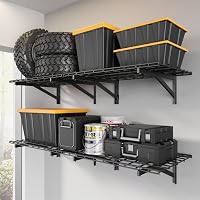
The Jusgym 2-Pack 2x4 Wall Shelves suits garages where clearing floor space is the priority. Its steel shelves mount to wood studs or solid concrete and brick walls, and Jusgym specifies expansion anchors for masonry.
The set includes 2 large and 6 small hooks for hanging items below. Reserve clearance for those items so they don't block a walkway or interfere with storage beneath the shelves.
Skip this system for metal walls or drywall-only mounting. Measure each shelf's 23.62 in depth and 46.06 in width against your available space.
Jusgym gives conflicting capacity figures: 250 lb per shelf in one description and 200 lb in its specifications. Confirm the applicable limit with Jusgym before planning your load; neither figure overrides a lower mounting limit.
Compare alternatives in our wall-mounted garage shelving guide. For a broader buying decision, how to choose garage shelving covers load, size, and anchoring.
What mistakes should you avoid when hanging shelves?
Avoid changing the support layout or hardware just to make installation easier. A shelf's capacity depends on the complete assembly, including its wall connections.
- Missing a stud center: An edge hit isn't a reason to keep tightening; correct the attachment location.
- Stretching bracket spacing: A wider unsupported span can let the shelf bend.
- Swapping fasteners: Similar-looking screws or anchors may have different uses.
- Overtightening: Stop if a screw spins freely, the wall crushes, or a bracket distorts.
- Using damaged holes: Loose or enlarged holes need an approved repair or a new mounting plan.
- Judging by appearance: A level shelf can still have the wrong fasteners or weak support.
Don't improvise a backing board to solve mismatched studs without an approved design. Its own attachments must carry the shelf and its contents.
How much weight can you put on wall shelves?
Stay within the lowest applicable limit for the shelf, supports, fasteners, and wall. Don't add individual anchor capacities together to invent a shelf capacity.
Include hooks and anything hanging from the assembly when planning the load. Place items as the shelf instructions require, and avoid concentrating dense objects at one end or along the front edge.
Keep frequently used items within easy reach. Store heavy objects low when practical so you don't need to lift them down from above your head.
Read how garage shelf weight limits work before filling the shelves. For a separate ceiling-mounted project, check how much weight a garage ceiling can hold before choosing a rack.
How do you check and care for mounted shelves?
Inspect the connections before loading, after loading, and periodically during use. Look again after an impact, a leak, or a major change in stored weight.
Check for loose hardware, wall cracks, pulled anchors, bent brackets, sagging, and corrosion. Follow the maker's care instructions, keep surfaces dry, and avoid hanging wet gear against the wall.
Don't deliberately overload the shelf or pull on it to judge its strength. Never climb, sit, or hang from it.
If anything shifts or cracks, stop using the shelf and unload it if you can do so safely. Resolve the mounting problem before returning items.
Which setup should you choose to hang garage shelves?
Choose by wall construction first, storage needs second. Knowing how to hang garage shelves includes recognizing when a different shelf system fits the job better.
Pick the Jusgym system for floor-clearing storage on compatible wood studs or solid masonry, after confirming its capacity. Choose the Franklin M210 when locating covered framing is part of the work.
Use the KURUI kit only for permitted light hollow-wall shelving. If your wall can't support the shelf you want, consider a suitable floor-standing unit and follow its anchoring instructions.
For the next decision, use how to choose garage shelving to match your wall, available space, and storage load before buying.
Frequently asked questions
Should garage shelves be screwed into studs?
Yes, if the shelves require wood-stud mounting, attach their supports to studs using the specified hardware; drywall alone cannot replace that framing support. For concrete, brick, or hollow walls, follow a mounting method the shelf maker expressly permits for the wall material and intended load.
Can you hang garage shelves without studs?
Yes, when the shelf instructions allow another mounting method, such as suitable anchors in solid concrete or brick; hollow drywall needs separate approval for the shelf and fasteners. The KURUI toggle kit suits selected light shelving projects, but it isn't recommended for heavy mounts or heavy ceiling installations.
How do you make sure wall shelves are level?
Use a level to mark the support positions before drilling, then check alignment again while securing the brackets or rail; measure from one shared reference line rather than from the floor at each bracket. After assembly, confirm the shelf sits correctly on every support before adding stored items.
How far apart should garage shelf brackets be?
Follow the shelf maker's bracket spacing because the permitted span depends on the shelf and support design; don't spread brackets farther apart just to reach convenient studs. If the mounting holes don't match your framing, choose a compatible system or obtain an approved mounting solution before drilling.