8 Best Garage Shelving Units (November 2026)
The best garage shelving units include the ROOMFAVE 48-Inch 5-Tier Shelving for bulky garage bins, the VEVOR 5-Tier Shelving 48x18x72 for tight parking aisles, and the ROOMFAVE 72-Inch 5-Tier Shelving for narrow wall sections.
On this page (7 sections)
- How we chose these garage shelving units
- The best garage shelving units for different layouts
- What should you compare before choosing garage shelving units?
- How should you set up and load garage shelving?
- How do you care for garage shelves after assembly?
- Which garage shelving mistakes should you avoid?
- Which garage shelving unit should you choose?
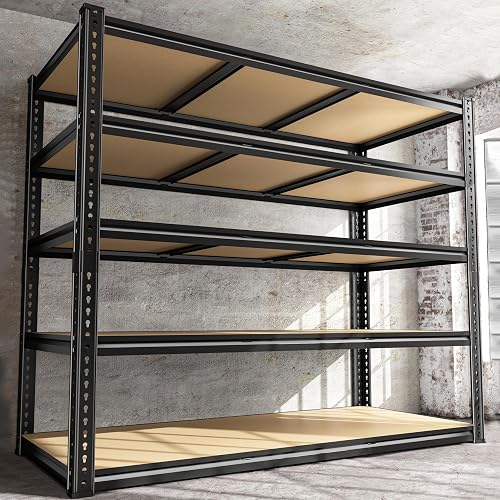
The ROOMFAVE 48-Inch 5-Tier Shelving is our top pick among garage shelving units for bulky bins and mixed household storage. Choose the compact ROOMFAVE for a smaller wall section, or PrimeZone if you prefer wire shelves.
The right rack must fit your containers, your walking space and the way you use the garage. A large capacity number won't help if a tote hangs over the edge or you can't open the car door.
For a broader overview, start with our garage shelving buying guide. If load limits are your main concern, see how much weight garage shelves can hold.
Our picks at a glance
-
1
-
2

-
3

- 4
 Check it
ZEUKMXOO 72-Inch 2400 lb Shelving
Best for separate storage zones - 5
 Check it
PrimeZone 48x24x72 5-Tier Shelving
Best for open bin storage - 6
 Check it
Nnovaroom 72-Inch 2400 lb Shelving
Best for compact utility storage - 7
 Best for flexible workshop layoutsCheck it
- 8
 Best for broad storage wallsCheck it
How we chose these garage shelving units
We compared usable size, shelf surface, layout options and stated load limits, with fit taking priority over the biggest capacity claim. CordialCue's picks cover deep-bin storage, narrow aisles, compact wall sections and separate storage zones.
A higher score reflects the overall fit for this search, not permission to load a rack beyond its instructions. Unclear dimensions or conflicting capacity figures matter because they can change which unit you should buy.
All eight choices stand on the floor. Plan the floor location and any required wall connection before deciding which rack belongs in your garage.
| Product | Best for | Size (W x D x H) | Stated total capacity | Construction | Our score |
|---|---|---|---|---|---|
| ROOMFAVE 48-Inch 5-Tier Shelving | bulky garage bins | 48 x 24 x 72 in | 3080 lb | Metal frame and MDF panels | 7.9 |
| VEVOR 5-Tier Shelving 48x18x72 | tight parking aisles | 2000 lb | SPCC carbon steel frame and MDF boards | 7.9 | |
| ROOMFAVE 72-Inch 5-Tier Shelving | narrow wall sections | 35.56 x 16 x 72 in | 2250 lb | Metal frame and MDF panels | 7.7 |
| ZEUKMXOO 72-Inch 2400 lb Shelving | separate storage zones | 2400 lb, confirm application to the pack | 7.2 | ||
| PrimeZone 48x24x72 5-Tier Shelving | open bin storage | 48 x 24 x 72 in | 7.1 | ||
| Nnovaroom 72-Inch 2400 lb Shelving | compact utility storage | 35.5 x 16 x 72 in | 2400 lb | MDF boards and metal frame | 7.0 |
| EKJ 72-Inch 2500 lb Shelving | flexible workshop layouts | 35.43 x 15.75 x 72.05 in | 2500 lb | 6.9 | |
| GarveeTech 60x24x72 Shelving | broad storage walls | 60.24 x 24.21 x 71.38 in | 3000 lb | Metal frame and MDF boards | 6.8 |
The best garage shelving units for different layouts
Choose ROOMFAVE for deep containers, VEVOR for a shallower aisle-side rack, or a compact model for a short wall section. Each option below suits a different storage plan, so start with what you need to put away.
ROOMFAVE 48-Inch 5-Tier Shelving: Best for bulky garage bins
- 48 x 24 x 72 in
- 5 adjustable tiers
- 3080 lb stated total capacity
- Can split into 2 racks
Deep shelves suit bulky containers that need full support front to back. Choose it for mixed storage along a clear wall with room to pull bins out.
Pros
- Continuous MDF shelf surfaces
- Adjustable in 1 in increments
- Can split into 2 racks
Cons
- Deep frame takes more aisle space
- MDF panels need protection from standing moisture
The larger ROOMFAVE suits buyers who want one main rack for bulky containers rather than several small storage spots. Its 48 x 24 x 72 in frame gives deep bins room without requiring the broadest wall in this group.
The metal frame holds MDF panels, with shelf heights adjustable in 1 in steps. That lets you give tall containers extra clearance while keeping smaller supplies from wasting a whole tall opening.
ROOMFAVE states 3080 lb total and 616 lb per shelf. Treat these as separate limits, and don't assume a dense machine part is suitable simply because its weight falls below the shelf figure.
Choose this unit for a dry garage with a clear wall and room to pull containers straight out. Skip it if the shelf front would crowd parking space, or if your storage area regularly gets wet.
The frame can become a 3-tier and a 2-tier rack. For other options centered on heavier storage, compare our guide to heavy duty garage shelving.
VEVOR 5-Tier Shelving 48x18x72: Best for tight parking aisles
- Nominal 48 x 18 x 72 in size
- 5 adjustable tiers
- 2000 lb stated total capacity
- Includes 2 anti-tipping brackets
A shallower frame suits storage beside a parking space where deeper shelves would crowd the aisle. Confirm the width before planning bin rows or a tight wall fit.
Pros
- Shallower than the deep-storage picks
- Can split into 2 racks
- Anti-tipping brackets included
Cons
- Less room for deep containers
- Conflicting width specifications need confirmation
VEVOR suits buyers who need storage beside a parking aisle and can't spare the depth of the larger racks. Its nominal 48 x 18 x 72 in size offers a middle ground between compact shelving and deep-bin storage.
Confirm its exact width before ordering because the dimensions conflict between 36 and 48 in. That difference changes both wall fit and the number of containers you can place across a shelf.
The powder-coated carbon steel frame uses MDF boards and adjustable tiers. VEVOR states 2000 lb total and 400 lb per shelf, and the frame can split into two shorter racks.
Two anti-tipping brackets and rubber foot pads are included. The brackets still need a suitable wall connection, while the pads don't remove the need for a firm, level base.
Choose VEVOR for containers that fit its shallower surface without overhang. Skip it if your largest totes need deep support or you need a fixed width confirmed before planning the room.
ROOMFAVE 72-Inch 5-Tier Shelving: Best for narrow wall sections
- 35.56 x 16 x 72 in
- 5 adjustable tiers
- 2250 lb stated total capacity
- Can split into 2 racks
The compact footprint suits smaller containers and short wall sections. Its split design also works for buyers who may later need two lower storage areas.
Pros
- Compact floor footprint
- Continuous MDF shelf surfaces
- Can split into 2 racks
Cons
- Less shelf area than the wider picks
- Deep totes may not fit
The compact ROOMFAVE suits small bins, boxed supplies and narrow wall sections where a wider rack would block something you use. Its 35.56 x 16 x 72 in frame is easier to place between existing garage features.
Metal uprights support MDF panels, and the shelves adjust to suit different container heights. ROOMFAVE states 2250 lb total and 450 lb per shelf.
Choose it when smaller containers will make up most of the load. Keeping those containers in a single visible row can be more useful than placing them on a deep shelf behind other supplies.
Skip it for oversized totes that need more front-to-back support. Measure the container's lid and handles, since a tapered base can fit while the wider top catches on an upright.
The split design makes a 3-tier and a 2-tier rack. Plan both locations before using that option, because lower racks trade vertical storage for more floor space.
ZEUKMXOO 72-Inch 2400 lb Shelving: Best for separate storage zones
- 2 units, about 36 x 16 x 72 in each
- 5 adjustable tiers per unit
- 2400 lb stated total capacity
- Freestanding design
Two full-height units let you separate household supplies from garage tools. Plan a location for each rack and confirm how the capacity applies before loading.
Pros
- 2 units in the pack
- Shelves adjust in 1 in increments
- Rubber feet included
Cons
- Requires space for both frames
- Pack-level capacity wording needs clarification
ZEUKMXOO is the choice for two separate storage zones without dividing one tall rack into shorter sections. Put related supplies near their point of use, such as vehicle-care items in one area and household bins in another.
The pack contains two five-tier units, each about 36 x 16 x 72 in. Shelf heights adjust in 1 in steps, which helps when the two zones hold different kinds of containers.
ZEUKMXOO states 2400 lb total and 480 lb per shelf, but the pack-level capacity wording needs clarification. Confirm the limit for each rack rather than assuming the total doubles because two units are included.
Choose this pack when you already have a purpose and location for both frames. Skip it if only one rack solves your storage problem or the second would sit in a walkway.
Rubber feet, a mallet and gloves are included. Assemble and check each rack separately, especially if the two locations have different floor conditions.
PrimeZone 48x24x72 5-Tier Shelving: Best for open bin storage
- 48 x 24 x 72 in
- 5 adjustable wire shelves
- Middle support beam on each tier
- Can split into 2 racks
Wire shelves suit broad-bottom containers and buyers who prefer an open shelf surface. Small parts need bins or trays, and load limits need confirmation.
Pros
- Metal wire shelf surfaces
- Middle support beams
- Can split into 2 racks
Cons
- Loose small items can fall through gaps
- Conflicting load figures need confirmation
PrimeZone suits buyers who prefer wire shelves for broad-bottom bins and boxed supplies. Its open surface gives it a different role from the MDF-panel choices, even though it shares the larger ROOMFAVE's 48 x 24 x 72 in footprint.
Each tier has a middle support beam, and metal connectors join the upper and lower support rods. Shelf heights adjust, and the frame can split into shorter racks or form a workbench.
Resolve PrimeZone's conflicting load figures before using it for heavy storage. Don't calculate a total by multiplying a per-tier figure when the brand also gives a separate overall limit.
Choose it for containers with bases that rest securely across the wire. Skip it for loose screws, narrow tool feet or small bottles unless you plan suitable bins or trays.
A liner won't raise the rack's load limit or turn every point load into an evenly spread load. Our guide to garage wire shelving explains more about organizing this shelf style.
Nnovaroom 72-Inch 2400 lb Shelving: Best for compact utility storage
- 35.5 x 16 x 72 in
- 5 adjustable tiers
- 2400 lb stated total capacity
- Wall anchors included
A compact rack for grouping small utility bins and garage supplies in one place. Fine shelf-height adjustments help reduce wasted space above shorter containers.
Pros
- Compact width and depth
- Adjustable in 1 in increments
- Wall anchors included
Cons
- Limited room for oversized containers
- Anchor suitability depends on the wall
Nnovaroom suits one compact utility station for small containers, boxed supplies and frequently used garage items. Its 35.5 x 16 x 72 in frame keeps the storage area contained rather than spreading supplies across a long wall.
The rack uses MDF boards, metal framing and reinforcing ribs. Its shelves adjust in 1 in steps, making it easier to leave useful hand clearance without wasting large gaps above short bins.
Nnovaroom states 2400 lb total and 480 lb per tier. Choose shelf positions around the actual containers before loading so you won't need to unload everything for a small height change.
Wall anchors, connectors, corner pads, gloves and a mallet are included. Check that the anchors suit your wall, and use our guide to anchoring garage shelving to plan the connection.
Choose Nnovaroom for a single narrow storage area. Skip it for broad containers or a two-zone plan that would be better served by a pack or a rack with a confirmed split configuration.
EKJ 72-Inch 2500 lb Shelving: Best for flexible workshop layouts
- 35.43 x 15.75 x 72.05 in
- 5 adjustable tiers
- 2500 lb stated total capacity
- Can split into 2 racks
Choose EKJ when a narrow storage rack may later become a lower work surface. Check the allowed configuration before planning workshop tasks around it.
Pros
- Cold-rolled steel frame
- Can split or form a workbench
- Adjustable shelf heights
Cons
- Limited surface area for large projects
- Workbench conversion does not guarantee suitability for impact work
EKJ suits buyers who want storage that can become a lower work surface as a workshop layout changes. The rack measures 35.43 x 15.75 x 72.05 in, so it fits a smaller work area than the wide, deep options.
Its cold-rolled steel frame has a powder-coated finish, adjustable tiers and reinforced double-layer legs. EKJ states 2500 lb total and 500 lb per shelf.
The frame can split into two racks or convert into a workbench. Choose it for a narrow storage plan where that lower configuration has a clear purpose, such as sorting parts or packing small boxes.
Skip it if your main need is a large project surface. A workbench configuration alone doesn't mean the rack is suitable for hammering, mounting a vise or other tasks that create impact and sideways force.
Use only the arrangement shown in the instructions. Check the allowed work-surface load and required supports before building your workspace around it.
GarveeTech 60x24x72 Shelving: Best for broad storage walls
- 60.24 x 24.21 x 71.38 in
- 5 adjustable tiers
- 3000 lb stated total capacity
- Can divide into separate racks
The widest frame here suits a broad wall where containers need room side by side. Choose it only after checking the full footprint and access around parked vehicles.
Pros
- Wide shelf layout
- Shelves adjust in 1.4 in increments
- Can divide into separate racks
Cons
- Largest footprint in this roundup
- Per-shelf load limit needs confirmation
GarveeTech suits buyers with a broad, clear wall and several containers to store side by side. At 60.24 x 24.21 x 71.38 in, it needs the most floor space of these eight choices.
The metal frame has MDF boards and reinforced crossbeams. Five shelves adjust in 1.4 in steps, and the unit can divide into separate racks.
GarveeTech states a 3000 lb total capacity. Confirm the per-shelf limit instead of dividing that figure by five and treating the result as an approved load.
Choose it when extra width lets you group related containers without placing them behind one another. Measure the clear space between uprights before assuming a particular row of bins will fit.
Skip it for a wall interrupted by doors, outlets you need to reach or parking clearance. Leave room to handle a full container at the shelf front, since fitting the frame alone doesn't make the space usable.
What should you compare before choosing garage shelving units?
Compare container fit and daily access first, then shelf surface, load limits and layout options. A rack should make your stored items easier to reach without creating a new obstacle beside the car or garage door.
How much width and depth do garage shelving units need?
Choose the shallowest shelf that fully supports your largest containers. Deeper shelves help with bulky bins, but they can hide small supplies and take space from the aisle.
Measure lids, handles and any bulging sides, then check the clear opening between uprights. Overall frame width isn't the same as usable shelf width.
Mark the proposed footprint on the floor with removable tape. Park normally, open the vehicle doors and walk past carrying a bin to check the space you'll use every day.
The garage shelving size guide can help you compare height and width with your room. Check doorways and turns too, particularly if you expect to move a rack after assembly.
Which shelf surface suits your storage?
Choose a continuous surface for small containers and uneven bases, or wire for broad-bottom items that sit securely across the gaps. Frame material alone doesn't tell you how the stored item will rest.
MDF panels need protection from standing water and repeated soaking. A powder-coated metal frame doesn't make the wood-based shelf panels waterproof.
Wire leaves openings beneath stored objects, so loose parts need containers. Check the base of each item rather than assuming that a large object always has a wide, stable contact area.
Our wire vs solid garage shelving comparison explains the surface tradeoffs. For a broader material comparison, read plastic vs metal garage shelving.
How should you read a capacity figure?
Follow both the whole-rack limit and each shelf's limit, along with the brand's load-distribution directions. An empty upper tier doesn't give you permission to overload the bottom one.
Weight distribution matters because a small, dense object presses on less surface than several spread-out boxes. Don't use broad capacity claims as permission to store machinery, filled tanks or other concentrated loads.
Leave room for future additions instead of planning every shelf at its limit. Check the floor's suitability for the combined rack and contents, especially on raised floors or surfaces with damage.
Do you need adjustable or split shelving?
Choose adjustable tiers for mixed container heights, and choose a split design only when shorter racks solve a real layout problem. Two low sections use more floor space than one tall unit.
Arrange your containers on paper before setting shelf heights. Allow enough room to grasp handles and lift a bin past the beam above it.
For storage built mainly around containers, our guide to garage shelves for totes and bins can help you plan rows and access. Standardizing a few bin sizes often makes shelf spacing easier.
How should you set up and load garage shelving?
Assemble the rack in its planned location, complete any required anchoring, then load it from the bottom up. Correctly seated connections matter more than matching a promised assembly time.
Check parts and frame alignment first
Lay out the uprights, beams, panels and supports before starting. Compare them with the instructions, and stop if a load-bearing part is bent, missing or won't connect as directed.
Wear the included gloves where appropriate, even on frames with rolled edges. Use the assembly tool as instructed and check each connection before adding the next tier.
Keep the frame square as you build. A panel should sit on its intended supports, and reinforcing bars must be installed wherever the instructions require them.
Finish the floor and wall checks before loading
Place every foot on a firm, stable surface. Don't make a rocking rack seem steady by adding weight, or balance it on scraps that can shift.
Follow the unit's instructions for leveling and anchoring. Keep access to the attachment points until the work is complete, and use wall hardware suited to the actual wall construction.
Freestanding describes how a rack stands; it doesn't cancel any anchoring requirement. Rubber pads protect contact points but don't secure the top of a tall frame.
Give heavy items and frequent-use items different places
Keep the heaviest suitable loads low, and put frequently used supplies where you can reach them comfortably. Reserve upper shelves for lighter items you can lift down safely.
Store each container with its label facing the aisle. Avoid placing a heavy box above a bin you remove often, where reaching past it could disturb the load.
Keep liquids upright in suitable containment and follow their storage instructions. Shelving doesn't replace a required cabinet or other special storage for hazardous materials.
How do you care for garage shelves after assembly?
Keep the shelves dry, clean spills promptly and check the frame whenever you change the load. Small changes are easier to address before a shelf is full.
Use a soft cloth and cleaning methods allowed by the brand. Avoid soaking MDF panels, and dry any surface you wipe with a damp cloth.
Look for swelling, sagging, bent supports, loose connections or damage around feet and anchors. Unload the affected section before investigating rather than pushing a loaded frame back into shape.
Recheck shelf spacing when storage changes. A new container should fit without forcing it past a beam, hanging it over an edge or blocking access to the wall connection.
Unload a rack before moving it or changing its configuration. These choices are floor-standing storage units, so don't drag them full or add wheels unless the brand approves the change.
Which garage shelving mistakes should you avoid?
Avoid buying by capacity alone, fitting containers by guesswork and filling every gap before checking access. Those choices can leave you with plenty of shelf area that is awkward to use.
- Choosing depth without checking the aisle. Measure the rack and the space needed to stand in front of it with a full bin.
- Counting bins by outside frame width. Uprights, lids and handles all affect how many containers fit across a tier.
- Keeping heavy items high. Place suitable heavy loads low instead of filling shelves in the order items come out of boxes.
- Using shelves as steps. Get a suitable step stool for upper storage and never climb the frame.
- Treating included anchors as universal. Match the connection to the wall and follow the rack's instructions.
- Ignoring a changed load. Recheck limits and support when replacing light holiday decorations with tools or bulk supplies.
Leave some clear space around frequently used containers. A tightly packed shelf can turn a quick task into unloading several unrelated items.
Which garage shelving unit should you choose?
Choose garage shelving units by the containers they must hold and the space you can keep clear. Eliminate racks that fail either check before comparing load claims or extra configurations.
Pick the larger ROOMFAVE for deep bins in a dry garage with enough aisle space. Choose the compact ROOMFAVE for a narrow wall, or VEVOR for a shallower parking-side layout after confirming its width.
Choose ZEUKMXOO when you need two full-height storage zones, PrimeZone when wire suits your containers, or Nnovaroom for one compact utility station. EKJ suits a changing workshop layout, while GarveeTech makes sense along a broad, uninterrupted wall.
Before ordering, write down your largest container size, available footprint and planned load on each tier. Use our garage shelving size guide to check that plan, then settle the shelf layout and anchoring before assembly.
Our top 3 picks at a glance
-
1
-
2
-
3
Frequently asked questions
How deep should garage shelving units be?
Choose the shallowest shelves that fully support your containers and still leave room to remove them. A 16 or 18 in depth can preserve aisle space, while 24 in shelves suit deeper bins; measure the widest part of each container, including its lid, and leave space for your hands.
Does a garage shelf's total capacity apply to each tier?
No; total capacity covers the whole unit, and each tier has its own limit. A partly empty rack can still have an overloaded shelf; follow both limits, spread weight as directed, and avoid treating a small, dense object like an evenly spread load across the entire shelf.
Should freestanding garage shelving be anchored?
Follow the shelving instructions for anchoring, including the required attachment points and wall fasteners; a freestanding design still needs protection against tipping where the instructions require it. Included brackets or anchors must suit your wall construction; our guide to anchoring garage shelving explains the main checks before loading.
Can adjustable garage shelving units be split apart?
Some can; both ROOMFAVE units, VEVOR, PrimeZone, GarveeTech and EKJ support layouts that divide the frame into separate racks. Use only the configurations described in the instructions; before loading either section, check its required supports, shelf positions, capacity and anchoring rather than carrying over assumptions from the full-height setup.


