Light Duty vs Heavy Duty Garage Shelving: Which Is Better? (November 2026)
For light duty vs heavy duty garage shelving, choose by your heaviest planned shelf load. Use lighter-duty storage for modest household supplies and higher-capacity racks for dense tools, while checking fit, material and each shelf's limit.
On this page (8 sections)
- Light duty vs heavy duty garage shelving: what changes?
- How do you work out the capacity you need?
- Which of these three racks suits your garage?
- Does plastic or metal matter more than the duty label?
- How much shelf space and aisle clearance do you need?
- How should you assemble and load garage shelving?
- What mistakes shorten the useful life of garage shelves?
- Which should you buy: light duty or heavy duty garage shelving?
For light duty vs heavy duty garage shelving, choose by the weight on your busiest shelf, then check that your items fit. Lighter-duty storage suits modest household supplies; higher-capacity racks make sense for dense tools and heavier containers.
The words “heavy duty” aren't a weight limit. A rack can have a large total capacity yet still be unsuitable for one heavy toolbox placed in the middle of a shelf.
Start with your storage plan, rather than the biggest capacity number. Our complete garage shelving guide covers the wider choice of rack types and layouts.
 Best for bulky workshop storage
SISESOL 71-Inch 5000 lb Garage Shelving

Light duty vs heavy duty garage shelving: what changes?
The useful difference is how much weight each shelf can support under its loading directions. Shelf size, bracing and material then determine how well that capacity serves your garage.
There isn't one capacity threshold that makes every rack light duty or heavy duty. Compare actual limits across models, including products that use the same duty label.
When is light duty garage shelving enough?
Light duty shelving is enough when your combined shelf loads stay within its limits and the items sit securely. Gloves, empty planters, folded tarps and small household supplies often need organization more than high capacity.
It also suits storage that changes often. Several small bins are easier to sort and lift than one large container packed with unrelated items.
Skip lighter-duty storage if one shelf must hold dense tools or several full containers near its limit. Don't rely on unused capacity elsewhere in the rack to cover an overloaded tier.
When should you choose heavy duty garage shelving?
Choose heavy duty shelving when your planned loads need higher per-shelf capacity. Tool cases, hardware bins and bulky workshop supplies call for a closer load check than empty seasonal containers.
Higher capacity doesn't solve every storage problem. A heavy item must also fit fully on the shelf, rest on suitable supports and be safe to lift into position.
Keep items that are too awkward to lift on the floor in a suitable location. Buying a stronger rack doesn't make lifting a loaded machine to shoulder height a sensible storage plan.
How do you work out the capacity you need?
Use the combined weight of everything planned for each tier, then compare it with that tier's limit. Check the whole unit's limit separately.
Make a simple shelf-by-shelf inventory before ordering. Include containers and trays in the load, and allow spare capacity for supplies you expect to add.
Read per-shelf and total limits separately
Nnovaroom claims 480 lb per tier and 2,400 lb total. ZEUKMXOO claims 140 lb per shelf and 700 lb total.
SISESOL claims 5,000 lb total, but you should confirm its per-shelf limit before buying it for a specific dense load. Don't divide a total by the number of shelves and treat the result as an approved limit.
Follow any conditions about evenly distributed weight. A load spread across a shelf creates a different demand from the same weight resting on a few small feet.
Our guide to how much weight garage shelves can really hold explains capacity figures and why concentrated loads deserve extra care.
Plan for changing contents
Leave some room below the stated limits rather than planning to fill every shelf to its maximum. A tote that holds holiday decorations today may hold hardware after the next garage cleanup.
Label bins by contents and keep dense items in smaller containers. This helps you judge loads and prevents a large bin from becoming too heavy to handle comfortably.
If you can't estimate an item's weight, weigh it or find a reliable weight before assigning it to a shelf. Guessing by size works poorly for metal parts and tool collections.
Which of these three racks suits your garage?
Choose SISESOL for broad storage, ZEUKMXOO for moisture-prone utility areas, or Nnovaroom for a narrower workshop layout. These are different storage jobs, so compare fit and materials alongside capacity.
| Product | Best for | Size (W x D x H) | Material | Claimed total capacity | Our score |
|---|---|---|---|---|---|
| SISESOL 71-Inch 5000 lb Garage Shelving | bulky workshop storage | 71.3 x 24 x 70 in | Metal | 5,000 lb | 8.6 |
| ZEUKMXOO 72-Inch Plastic Shelves | damp utility spaces | 35.43 x 16.93 x about 72 in | Polypropylene plastic | 700 lb | 7.1 |
| Nnovaroom 72-Inch 2400 lb Shelving | narrow workshop spaces | 35.5 x 16 x 72 in | Metal and MDF boards | 2,400 lb | 7.0 |
SISESOL 71-Inch 5000 lb Garage Shelving
Choose the SISESOL for large containers and workshop supplies along a clear wall. Its 71.3 in width, 24 in depth and 70 in height create a broad storage area that needs careful floor planning.
The metal frame has one-piece uprights, eight lateral bars and adjustable shelves with locking pins. Those features make it worth considering when you want a braced rack with room to arrange bulky items.
Plan shelf spacing around your tallest containers before loading. Put everyday items toward the front so the extra depth doesn't turn the rear of each shelf into forgotten storage.
Skip it if your garage has a narrow walking route or you only need space for small supplies. Its 80 lb unit weight also makes it a rack to position thoughtfully before filling.
ZEUKMXOO 72-Inch Plastic Shelves
Choose the ZEUKMXOO for contained household supplies in a damp garage, laundry area or basement. The polypropylene construction won't rust, and its footprint is 35.43 in wide, 16.93 in deep and about 72 in high.
It has five tiers, tool-free snap-fit assembly and adjustable feet. Open slats suit bins and trays better than loose screws, narrow bottles or objects with small feet.
ZEUKMXOO describes the plastic as waterproof and UV-resistant, while noting that prolonged intense sunlight may shorten its life. A sheltered location is a sensible choice when you don't need outdoor placement.
Skip it for loads beyond its shelf limits or containers that need more support area. Measure tote bases and lids yourself, since a gallon label doesn't tell you whether a bin fits.
Nnovaroom 72-Inch 2400 lb Shelving
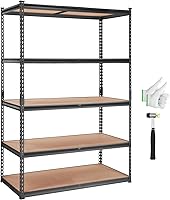
Choose the Nnovaroom for compact tool storage where a deep rack would crowd the aisle. It measures 35.5 in wide, 16 in deep and 72 in high, with five tiers.
Its construction combines metal with MDF boards, and shelf heights adjust in 1 in increments. That spacing helps you fit mixed-height containers without leaving a large empty gap above every bin.
A mallet, gloves and wall anchors are included. Check that the anchoring hardware suits your wall before using it, rather than assuming included hardware fits every installation.
Skip it for bulky containers that extend beyond the shelf supports or for a spot exposed to standing water. The metal frame doesn't remove the need to protect MDF shelf boards from moisture.
Does plastic or metal matter more than the duty label?
Choose material for the room's conditions and the items resting on the shelf. Capacity still needs its own check, regardless of whether the rack is plastic or metal.
Plastic is useful where rust is a concern. Open shelves can let air move around bins, but they don't keep contents dry or make damp storage harmless.
Coated metal needs care at scratches and joints. Wipe away moisture and inspect damaged areas before corrosion spreads, following the brand's care directions for any repair.
MDF shelf boards need protection from wet containers, leaks and standing water. If shelves become swollen or damaged, unload the affected tier and resolve the problem before using it again.
Our plastic vs metal garage shelving comparison explains the material tradeoffs. For small parts, use bins or trays that sit securely without interfering with shelf supports.
How much shelf space and aisle clearance do you need?
Buy the smallest footprint that fully supports your items and leaves useful access. A larger rack can waste space if it blocks car doors, a workbench or the route through the garage.
Measure your largest container at its widest points, including handles and lid edges. Check the base too, since it needs proper support even when the lid appears to fit.
Mark the rack's footprint on the floor with removable tape. Open nearby doors, walk past with a full-size tote and check whether you can reach the rear of the planned shelves.
Measure usable shelf openings as well as outside dimensions. Uprights and supports can reduce the space available for sliding bins in and out.
For height, allow room to grasp a handle and lift a lid where needed. Use the garage shelving dimensions guide to turn those measurements into a workable layout.
If bins are your main storage method, compare their shape and access needs in our guide to garage shelves for totes and bins.
How should you assemble and load garage shelving?
Assemble the rack in its final position on a suitable floor, following the exact instructions. Finish the structure and any required anchoring before placing storage on it.
Clear enough space to lay out parts and identify connectors. Check for damaged pieces early, so you don't build around a bent beam or a cracked shelf.
Seat each connection fully and install every required brace, pin and shelf support. Don't omit a brace to make room for a taller bin.
Set shelf heights while the rack is empty. Before changing them later, unload the affected sections and follow the instructions for supporting the frame.
How do you handle an uneven garage floor?
Level the rack using the method the brand allows. An uneven stance can make loading less stable and prevent frame parts from sitting as intended.
Adjustable feet can help with small differences, but they don't make every sloping or damaged surface suitable. Avoid loose stacks of scrap material under the legs.
Do garage shelves need wall anchors?
Follow the anchoring requirements for the exact rack. Freestanding describes how a rack stands, but doesn't settle every installation requirement.
Use fasteners suited to the wall structure and follow the rack's directions. Our guide on whether to anchor garage shelving explains the checks to make before loading.
Anchoring doesn't increase shelf capacity. Keep heavy items low, avoid climbing on the rack and keep the floor clear so you can retrieve items without pulling sideways on the frame.
What mistakes shorten the useful life of garage shelves?
The biggest mistakes are overloading individual tiers, ignoring moisture and moving a loaded rack. Good daily use matters as much as choosing a suitable capacity.
Don't drop heavy tool cases onto a shelf. Place them down carefully and spread loads as directed, especially when an object rests on small feet or a narrow base.
Don't add boards, liners or extra tiers and assume the original capacity still applies. Accessories can change how weight reaches the shelf supports, so use only arrangements the instructions allow.
Unload a rack before moving it unless its instructions explicitly allow loaded movement. If frequent repositioning is part of your plan, consider purpose-built garage shelves on wheels and check their movement limits.
Wipe spills promptly and keep chemicals in suitable closed containers. Follow each chemical's storage directions rather than grouping incompatible supplies together just because they fit.
Inspect shelves after a leak, impact or major reorganization. Stop using a tier with new sagging, cracks, loose joints or damaged supports until the cause is resolved.
Which should you buy: light duty or heavy duty garage shelving?
Resolve light duty vs heavy duty garage shelving by choosing for your heaviest planned tier, your largest container and the conditions in that part of the garage. All three need to fit the rack.
Choose ZEUKMXOO for modest household loads where moisture resistance and simple assembly matter. Choose Nnovaroom for heavier compact storage in a dry location with limited floor depth.
Choose SISESOL when you have an open wall for bulky workshop storage, after confirming the shelf limit for your load. Skip a larger rack if its footprint makes daily access harder.
Before ordering, write down your shelf loads and mark the footprint on the floor. Then use our guide to choosing garage shelving by load, size and anchoring to check the final plan.
Frequently asked questions
What is the difference between light duty and heavy duty garage shelving?
Light duty shelving suits modest household loads, while heavy duty shelving generally supports denser storage. Neither label gives you a usable weight limit by itself; compare the exact unit's per-shelf capacity, total capacity, dimensions and loading directions, then match those details to the items you plan to store.
How much weight can light duty garage shelves hold?
There is no single weight limit for light duty garage shelves; check the exact model's per-shelf and total limits, including any requirement to spread weight evenly. Don't calculate a shelf limit by dividing the total yourself; our guide to garage shelf weight limits explains how to read those figures.
Do heavy duty garage shelves need to be anchored?
Follow the exact unit's anchoring instructions, even if it's described as freestanding. Anchoring helps control tipping, but it doesn't increase shelf capacity or fix poor assembly; use hardware suited to the wall and installation; our guide on anchoring garage shelving explains what to check before loading a rack.
Are plastic garage shelves light duty?
Plastic doesn't automatically mean light duty, because capacity depends on the design and model. ZEUKMXOO claims 140 lb per shelf for this unit; compare your planned load with that limit and follow the loading directions, while also checking whether the shelf surface supports your containers and small items.
How deep should garage shelving be?
Choose shelf depth around your largest stored items and the aisle you need to keep clear. Measure container bases, lids and handles rather than using gallon size alone; shallow shelves improve access in tight spaces; our garage shelf depth guide explains when extra depth is worth the floor space.